
Malaysia has no commercial date-growing trade, so every date sold here is imported. If you searched for "date exporter to Malaysia", you are looking at the far end of that chain: the packinghouse or trader who loads the fruit, writes the quote and signs the papers. This guide is about what a Malaysian buyer should ask that exporter before money changes hands, with Iranian varieties as the running example.
It draws on four outside sources, all checked in November 2026: the FAO date palm handbook (Plant Production Paper 156), the US trade.gov guide to Incoterms, the import pages of MAQIS, Malaysia's quarantine and inspection department, and one 2024 residue study on Mazafati. Prices come from one Malaysian wholesaler's list, checked the same month.

Iranian varieties and what each asks of the shipment
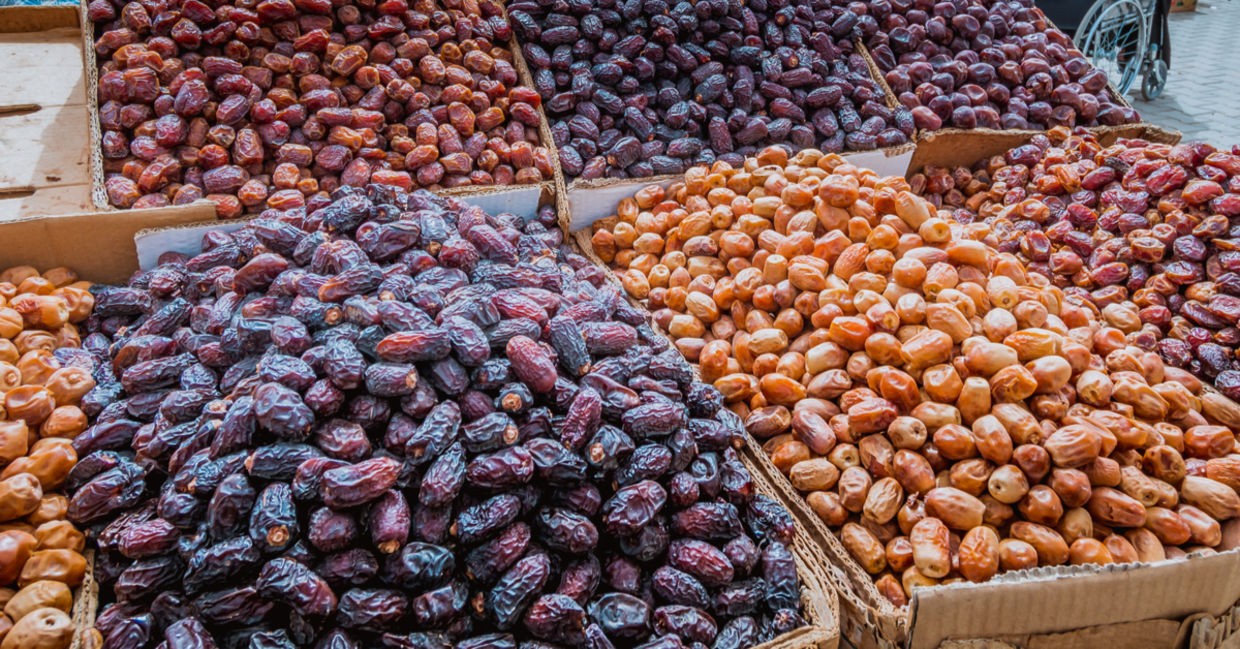
Start with the fruit. Mazafati needs refrigeration, the other three on this list are semi-dry, and the questions for the exporter follow from that.
| Variety | Origin | Description | Question for the exporter |
|---|---|---|---|
| Mazafati (Rotab Mazafati Bam, kurma madu) | Bam, Kerman province, Iran | Dark, very soft, high moisture; needs refrigeration; cold-stored and sold year-round | Is the container refrigerated, and is a temperature recorder loaded with the fruit? |
| Piarom | Iran (Hormozgan) | Dark, semi-dry, thin skin | Which grade, and how does this exporter define it by size? |
| Mariami | Iran | Dark, semi-dry, chewy | Which grade, and is it sold under its own name or as Piarom? |
| Sayer (also traded as Stamaran) | Iran (Khuzestan) | Amber-brown, semi-dry | Is the lot labelled Sayer? It is not Shahani, which is a separate variety. |
Grade names deserve a second look. A, AA, AAA and Jumbo are each importer's own size sorting, not an international standard, so a sample and a written size description are worth more than the letters on the quote.
Choosing a date exporter to Malaysia: read the quote terms first
An export quote may be written with a three-letter Incoterm such as FOB or CIF. trade.gov describes the Incoterms as 11 rules issued by the International Chamber of Commerce, which set out who pays for and manages the shipment, insurance, documentation, customs clearance and other logistics. Each rule also fixes the point at which the risk of loss or damage passes from seller to buyer.
The name and the place after it matter. FOB is Free on Board, followed by the named port of loading. CFR is Cost and Freight, and CIF is Cost Insurance and Freight, both followed by the named port of destination. So "FOB Bandar Abbas" and "CIF Port Klang" are not two prices for the same thing. The CIF name covers freight and insurance; the FOB name mentions neither.
Can a contract still cite Incoterms 2010? trade.gov says yes, if both parties agree and the version is correctly identified on the export documents.
Sea, air and the timing trade-off
The FAO handbook lists four ways dates move for export: overland, by sea, overland and sea combined, and by air. Its advice is to pick the cheapest one that still delivers the fruit undamaged and at the right time. It calls sea containers an efficient and relatively cheap option, with the fruit protected from the moment it leaves the producer to the moment it reaches the customer's door. In a refrigerated container, cold air flows horizontally over the layers of fruit and spreads evenly through the box.
Air is the most expensive, FAO says, but sometimes unavoidable when fruit must arrive at short intervals. Timing can also push a shipper toward dearer transport, for example at the start of the season to reach a market before other suppliers.
For Malaysia the calendar is easy to name. Demand peaks before and during Ramadan, and Hari Raya, weddings (hantaran), kenduri and umrah gifts are other peaks. If an arrival date is a condition of the deal, put it in writing and ask how it changes the shipping method and the price.
Documents the exporter should hand over
FAO is plain on this. Every shipment should be documented in detail, and besides the customs, payment and transport papers, a phytosanitary certificate should go with the fruit. That certificate is issued by the relevant authorities and states that the fruit is free of pests and diseases and meets the importing country's standards.
On the Malaysian side, the paperwork starts with the buyer, not the exporter. MAQIS asks anyone registering as an importer to complete its Borang Syarat-syarat Pendaftaran, begin in the SPEED system, and apply for the MAQIS permit through ePermit Dagang Net. Its food page adds that registration steps differ for a company and for an agent-importer, and it points food-import questions to the Food Safety and Quality Division of the Ministry of Health. Those pages are about food imports generally and do not single out dates.
Labels belong in the same conversation. FAO notes that in most importing countries the law requires weight, country of origin, quality and expiry date on the package, and that all labels and markings should be checked against the law and the customer's needs in the importing country.
Quality checks worth asking about
The FAO handbook lists what a packinghouse checks around the packing line: clean conveyor belts, calibrated scales, the writing on the packages, a working metal detector (installed on every retail packing line), repacking and marking equipment, and qualification for standards such as ISO and HACCP. Asking which of these a date exporter to Malaysia can show you is a fair first filter.
Ask about spraying records too. FAO writes that many clients, especially in European markets, want growers to document their quality control, including a report on spraying against insects with the materials, dates, concentrations, days before harvest and residue levels. Permitted residue levels are set in the Codex Alimentarius. For Mazafati there is one recent data point: a 2024 study (PMID 38468010) tested 12 fresh Mazafati samples from Bam for 47 pesticides. Only diazinon turned up in the fruit, at a mean of 0.037 mg/kg, and most samples were below the national limit for dates the paper cites, 0.05 mg/kg.
Two more FAO lines are practical. Fruit is sometimes held for up to several months before shipment, so each consignment should be sampled to confirm the quality has not changed. And for fresh dates at the khalal or rutab stage, a temperature recorder should travel in the container; the customer signs for the goods only if the record matches the agreed conditions. If you are building your own checklist, it helps to know how to trace a lot back to where it was packed, and this piece on traceability and origin in the dates trade walks through what that record should hold.
Bulk for repacking, or retail-ready?
FAO describes bulk fruit that may be handed over for repacking in the country where it will be sold, with retail packing done to the customer's requirements there. Retail packs, by contrast, carry the details the shop needs, such as nutritional composition and the last date for sale or use. Settle which one you are buying before the quote, since it can change who prints the labels for Malaysia. Responsibilities on both sides of the deal are covered in more general terms in this post on what date-exporting companies are responsible for, and the habit of starting with a small trial order is in the guide to finding a reliable kurma supplier in Malaysia.
What Iranian dates fetch once they are here
A landed cost only means something next to a selling price. Below is every Mariami listing and every 12 × 600g rotab listing on one Malaysian wholesaler's list, checked in November 2026. The list had no listing named Piarom or Sayer. Names are copied as listed.
| Listing | Pack | Price | RM per kg | Stock when checked |
|---|---|---|---|---|
| Mariami A Normal 2026 | 5kg | RM75 | RM15.00 | In stock |
| Mariami AA 2026 | 5kg | RM129 | RM25.80 | In stock |
| Mariami AAA VIP 2026 | 5kg | RM148 | RM29.60 | In stock |
| 1kg Mariami AAA | 1kg | RM40 | RM40.00 | In stock |
| Mariami A no.2 | 5kg | RM68 | RM13.60 | Out of stock |
| Mariami AA (No.2) | 5kg | RM80 | RM16.00 | Out of stock |
| Mariami AA Pouch Bag 2026 | 200g × 24 | RM147 | RM30.62 | Out of stock |
| Mariami AA Pouch Bag | 400g × 12 | RM153 | RM31.88 | Out of stock |
| Mariami Jumbo Premium Box | 500g × 12 | RM235 | RM39.17 | Out of stock |
| Rotab Mazafati AAA | 600g × 12 | RM86 | RM11.94 | Out of stock |
| Rotab BAM AAA | 600g × 12 | RM88 | RM12.22 | Out of stock |
| Rotab | 600g × 12 | RM90 | RM12.50 | Out of stock |
Two things stand out. The in-stock Mariami range runs from RM15 to RM40 a kilo, and the 1kg pack costs more per kilo than any in-stock Mariami 5kg pack. And all three 12 × 600g rotab listings, including Rotab Mazafati AAA, were out of stock on the day. Mazafati is cold-stored and sold year-round, so an empty shelf on one list is a stock gap, not a season ending.
Short answers
Does the exporter get my Malaysian import permit?
MAQIS registers the importer and issues the permit through ePermit Dagang Net, so that side sits with the Malaysian buyer or an agent-importer. On FAO's list, the shipment itself travels with customs, payment and transport papers plus a phytosanitary certificate.
Is a CIF price the full cost to my store?
CIF names cost, insurance and freight to the named destination port. Anything after the port, such as clearance and the lorry to your store, needs its own line in your sums.
Do I need a refrigerated container?
For Mazafati, which needs refrigeration, ask for one, along with a temperature recorder. For semi-dry varieties, ask the exporter what conditions they ship under and get it in writing.
Before you sign with a date exporter to Malaysia, get the Incoterm and its named port on paper, next to the variety, grade and size description. For Mazafati, add the temperature terms. Then ask for the list of documents that will travel with the container. More about this site is on the About Us page and the contact page.